
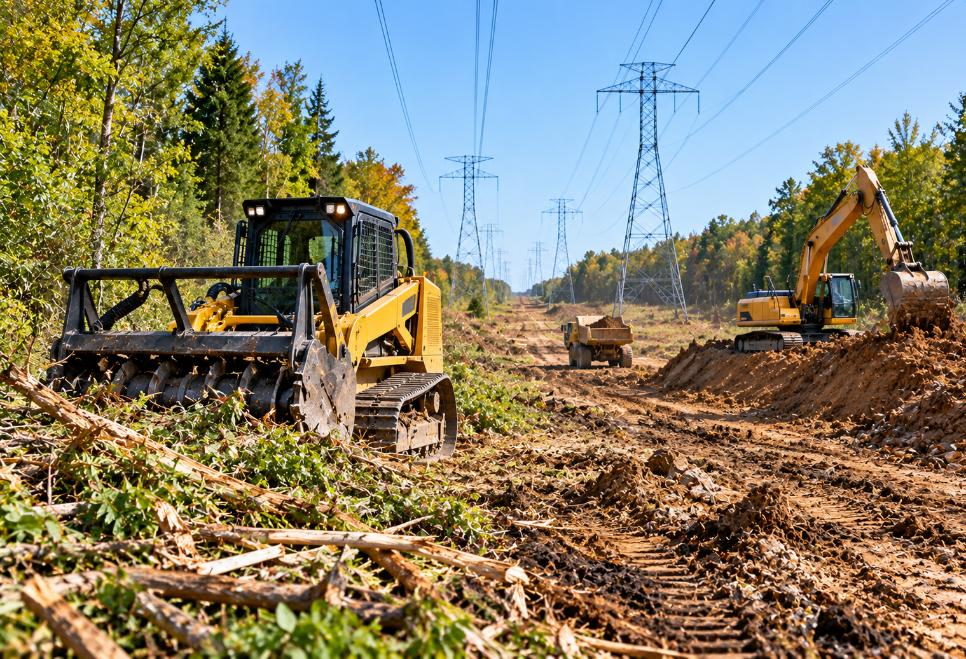
Clearing High-Voltage Utility Corridors: Brush Clearing & Mass Earthmoving in Monclova Township
High-voltage utility corridors require more than routine land clearing. In Monclova Township, crews may be working around active infrastructure, drainage concerns, heavy vegetation, uneven ground, and access points that must remain usable for utility equipment.
For property owners, utilities, contractors, and project managers, successful corridor preparation starts with controlled brush clearing and earthmoving that creates safe, stable access without treating the site like an ordinary vacant lot.
Quick answer: Brush clearing and mass earthmoving in a high-voltage utility corridor typically involve removing obstructive vegetation, opening equipment access, grading uneven terrain, managing displaced soil, and preparing working areas around existing utility infrastructure. In Monclova Township, local drainage conditions, clay-rich soils, roadside access, surrounding development, and buried utilities can all influence how clearing and grading should be planned.
What local project owners should know
-
Utility corridor clearing should preserve required access while avoiding unnecessary disturbance outside the approved work area.
-
Clay-rich soils found across northwest Ohio can become difficult to work when saturated, making weather and ground conditions important scheduling considerations.
-
Monclova Township includes township, county, and state-maintained roads, so hauling and equipment access may involve different roadway authorities depending on the site.
-
Underground utilities must be identified before excavation or grading begins, even when overhead electrical infrastructure is the most visible feature.
-
Brush removal and earthmoving should be coordinated so freshly cleared ground does not create avoidable erosion, rutting, or drainage problems.
Why Does Utility Corridor Clearing Matter in Monclova Township?
Utility corridor clearing matters in Monclova Township because dependable access is essential for inspection, maintenance, construction, and emergency work around electrical infrastructure. Dense brush, volunteer trees, soft ground, drainage problems, and uneven grades can slow equipment movement and make already sensitive work areas harder to manage.
The township sits within a developing part of Lucas County where residential areas, agricultural ground, major roads, utility infrastructure, and open land can exist relatively close together. Local routes including Monclova Road, Albon Road, Briarfield Boulevard, Airport Highway, and Maumee-Western Road also create access considerations for heavy equipment and trucking.
Klumm Bros. provides excavation, land clearing, and earthmoving support for projects in the Toledo area. For corridor work, we focus on creating practical access and workable ground conditions while respecting the limits and requirements established for the site.
What Do Local Soil and Site Conditions Mean for Earthmoving?
Local soil conditions can make moisture management one of the biggest factors in earthmoving around Monclova Township. USDA soil information for northwest Ohio identifies clay-rich soils with relatively slow permeability, while some low-lying soils in Lucas County are poorly drained, conditions that can affect excavation, hauling, compaction, and equipment mobility.
That means a corridor that looks firm from the road may perform differently once clearing begins or after sustained rainfall. Heavy machines can create deep rutting in saturated areas, while excavated clay can be difficult to place and grade efficiently when moisture conditions are unfavorable.
Local topography and drainage also matter. Portions of the township contain wetlands, floodplain considerations, agricultural drainage features, and developed properties, so moving soil without understanding where water already travels can create problems beyond the immediate work zone.
How Does Corridor Clearing Affect Utility Access?
Corridor clearing improves utility access by creating enough usable space for crews, trucks, tracked equipment, and maintenance operations to move through the right-of-way. The goal is not simply to remove every plant, but to establish the visibility, width, and ground conditions needed for the specific utility project.
Depending on the approved scope, work may include cutting brush, removing small trees, processing vegetation, stripping unsuitable material, building temporary equipment paths, cutting high areas, filling low spots, or creating working pads.
High-voltage environments also require disciplined coordination. Equipment movement, vegetation height, excavation limits, and staging locations should follow the requirements established by the utility owner and project team.
What Warning Signs Show a Utility Corridor Needs Clearing or Grading?
A utility corridor may need professional clearing or grading when vegetation or ground conditions begin restricting safe, reliable access for inspection, construction, or maintenance equipment. Around Monclova Township, changing seasonal conditions can make existing access problems more noticeable after spring saturation, summer growth, or prolonged wet weather.
Common warning signs include:
-
Dense brush is narrowing an established access path.
-
Volunteer trees or woody vegetation are becoming difficult to manage.
-
Equipment routes contain deep ruts, soft spots, or standing water.
-
Existing grades push runoff toward areas where crews need to travel.
-
Spoil piles or previous excavation have reduced usable working space.
-
Uneven terrain limits access for trucks or tracked equipment.
-
Culverts, drainage swales, or field drainage areas are obstructed.
-
Vegetation prevents clear visibility across portions of the work area.
When Should You Call a Professional Excavation Contractor?
A professional excavation contractor should be involved when corridor work requires heavy vegetation removal, large-volume soil movement, access-road construction, grading, drainage adjustments, or operation near existing utilities. These conditions require equipment selection, sequencing, and site awareness beyond what routine landscaping or small-scale brush cutting provides.
Property owners can safely observe vegetation growth, drainage patterns, and visible access problems. Actual excavation should not begin until underground utility locating and project-specific requirements are addressed.
Monclova Township advises contacting Ohio 811 before digging so underground facilities can be marked. Utility owners and project managers may impose additional requirements for work inside transmission or distribution corridors.
What Common Conditions Complicate Corridor Clearing in Northwest Ohio?
The most common complications are wet clay soils, fast vegetation growth, drainage constraints, limited access, and nearby infrastructure. In the Toledo and Lucas County area, these factors can overlap, turning what appears to be straightforward clearing into a project that requires coordinated vegetation removal and earthmoving.
Wet or clay-heavy ground: Saturated soil may rut under heavy machines and become difficult to grade.
Low areas and drainage paths: Filling or tracking through a low spot without understanding drainage can redirect water or create persistent access problems.
Mature woody growth: Larger brush and trees generate more material and require different handling than mowing grasses or light vegetation.
Existing utilities: Underground lines, poles, towers, guy wires, and other infrastructure can restrict equipment positioning.
Road access: Sites near Monclova Road, Airport Highway, Waterville-Monclova Road, or other local routes may require careful planning for equipment delivery and trucking.
How Can Utility Corridors Be Maintained After Initial Clearing?
Utility corridors stay more manageable when vegetation and access conditions are monitored before heavy regrowth or major erosion develops. Regular inspections can identify encroaching brush, drainage issues, rutting, washouts, and soft areas while repairs are still relatively localized.
Seasonal timing matters in northwest Ohio. Spring moisture can expose drainage and bearing problems, while summer growth can quickly reduce visibility in previously cleared areas. Late fall and winter conditions can also change soil behavior depending on rainfall, freezing, and thawing.
A practical maintenance approach is to address woody vegetation early, preserve functional drainage, repair damaged access routes, and avoid repeatedly driving heavy equipment through saturated ground when operations can be scheduled for better conditions.
What Results Should You Expect From Professional Corridor Clearing?
Professional corridor clearing should produce a work area that better supports the access, visibility, drainage, and equipment movement required by the approved project. The exact finished condition depends on the utility specifications, terrain, soil conditions, environmental limits, and whether the corridor needs temporary construction access or longer-term maintenance access.
Some projects primarily need brush and tree removal. Others require substantial cut-and-fill work, rough grading, stabilization, or reconstruction of an existing access route.
We evaluate the clearing and earthmoving portions together so vegetation removal does not create a site that becomes unnecessarily difficult to grade or maintain afterward.
What Are Common Mistakes During Utility Corridor Preparation?
Common mistakes include clearing without an earthmoving plan, grading wet soil, overlooking drainage, and treating utility access like ordinary site clearing. Each can create additional work or interfere with the intended use of the corridor.
Mistake: Clearing vegetation first without planning equipment access.
Consequence: Brush piles and disturbed ground can block the machines needed for later grading.
Better approach: Sequence clearing, material handling, and earthmoving around the intended travel path.
Mistake: Working saturated clay aggressively.
Consequence: Heavy equipment can create deep rutting and unstable subgrade.
Better approach: Adjust operations to actual ground conditions whenever project scheduling allows.
Mistake: Ignoring existing drainage.
Consequence: New grades may trap water or redirect runoff.
Better approach: Identify swales, culverts, depressions, and drainage paths before moving large volumes of soil.
Mistake: Assuming overhead lines are the only utility concern.
Consequence: Underground facilities may still cross the work zone.
Better approach: Complete required utility locating before excavation begins.
What Is a Common Utility Corridor Scenario in Monclova Township?
A common local scenario is an overgrown corridor crossing a mix of open ground and low areas where maintenance vehicles can no longer move efficiently. Brush may first need to be cut and processed before excavation equipment can reach soft sections, old ruts, or uneven grades.
The project may then require selective soil movement to restore access while maintaining surrounding drainage. Material handling and trucking have to be coordinated with nearby road access, and work must remain within the limits established by the utility or project owner.
This is a representative scenario, not a description of a specific Klumm Bros. project.
What Services Support High-Voltage Corridor Preparation?
The services that support utility corridor preparation typically include land clearing, brush removal, excavation, mass earthmoving, grading, access preparation, and material handling. Combining these operations under a coordinated site plan can reduce conflicts between vegetation removal and the heavy equipment work that follows.
For Toledo-area utility, infrastructure, industrial, and sitework projects, we can evaluate what equipment and excavation approach fit the terrain and project scope.
How Do You Compare Light Clearing With Full Corridor Earthwork?
Light clearing is appropriate when vegetation is the main obstacle, while full corridor earthwork becomes necessary when ground elevations, soft areas, drainage, or equipment access also need correction. Choosing the right scope starts with understanding what the corridor must support after the vegetation is gone.
Brush-only work may restore visibility but leave existing ruts and poor access untouched. Earthmoving can address those physical limitations, but it introduces additional planning for excavation limits, soil placement, drainage, and stabilization.
For larger projects, planning both phases together can provide a clearer path from initial clearing to a usable work area.
Where Do We Provide Excavation and Clearing Services?
We support projects in Monclova Township and throughout the greater Toledo area, including surrounding communities such as Maumee, Waterville, Whitehouse, Holland, and other parts of Lucas County. Project availability and scope depend on the site, access conditions, and required work.
What Can Happen If Corridor Maintenance Is Delayed?
Delaying necessary corridor clearing can allow woody vegetation, drainage problems, rutting, and access restrictions to become more difficult to address. For utility work, poor access can also complicate future inspections, construction activities, vegetation management, and equipment mobilization.
The goal is not to clear land unnecessarily. It is to maintain the level of access required for the corridor’s intended use before vegetation and ground problems create a larger earthwork project.
FAQ About Utility Corridor Clearing in Monclova Township
Do high-voltage utility corridors in Monclova Township need complete vegetation removal?
No. The required clearing depends on the utility owner’s specifications, project limits, vegetation type, and required access. Some areas may need substantial brush or tree removal, while others may only require selective clearing. Work should follow the approved corridor plan rather than automatically removing all vegetation.
Why can clay soil make mass earthmoving difficult around Monclova Township?
Clay-rich soil can hold moisture and become soft, sticky, and difficult to grade when wet. USDA soil information for northwest Ohio identifies several local soil types with slow permeability or drainage limitations. Contractors must consider actual site moisture, equipment loading, and intended finished conditions before moving large quantities of material.
Do I need Ohio 811 before excavation in a utility corridor?
Yes, underground utility locating is a critical step before excavation. Monclova Township specifically directs people to contact Ohio 811 before digging. A corridor containing visible electrical poles or transmission infrastructure may still contain other buried facilities, so overhead visibility does not eliminate the need for underground utility identification.
Can brush clearing and grading be completed as one project?
Yes, brush clearing and grading can often be coordinated as parts of the same sitework project when both are required. Planning them together helps determine where vegetation will be processed, how equipment will enter the site, where soil will move, and which areas must remain open for utility operations.
What local roads may affect equipment access in Monclova Township?
Access may involve township, Lucas County, or state-maintained roads depending on the corridor location. Roads such as Monclova Road, Albon Road, Waterville-Monclova Road, Maumee-Western Road, and Airport Highway fall under different jurisdictions, making route planning and site access an important early consideration for heavy equipment projects.
Is standing water in a utility corridor always a grading problem?
No. Standing water may result from existing drainage patterns, soil characteristics, recent rainfall, wetlands, blocked drainage features, or previous grading. The cause should be understood before earth is moved. Simply filling a wet area can redirect water or create a different problem elsewhere on the property.
When is the best time for earthmoving near Toledo?
The best timing generally depends on current soil moisture and project requirements rather than a single calendar month. Northwest Ohio sites can be particularly difficult when clay-rich ground is saturated. Scheduling substantial grading during firmer ground conditions can reduce rutting and make soil handling more efficient when the project allows flexibility.
Can Klumm Bros. handle both clearing and heavy earthmoving?
We can evaluate projects requiring land clearing, excavation, grading, and mass earthmoving in the Toledo-area market. The specific equipment, sequencing, and scope depend on the corridor, access, soil conditions, utility requirements, and amount of vegetation or material that must be handled.
Prepare the Corridor for Reliable Access
High-voltage utility corridor work in Monclova Township requires careful coordination between vegetation removal, equipment access, drainage, soil conditions, and existing infrastructure. Addressing those factors together can create a more practical site for the utility work that follows.
Keep Your Monclova Township Utility Project Moving
We approach clearing and earthmoving with the equipment, sequencing, and site awareness required for demanding Toledo-area projects.
Categorised in: Excavation Company