
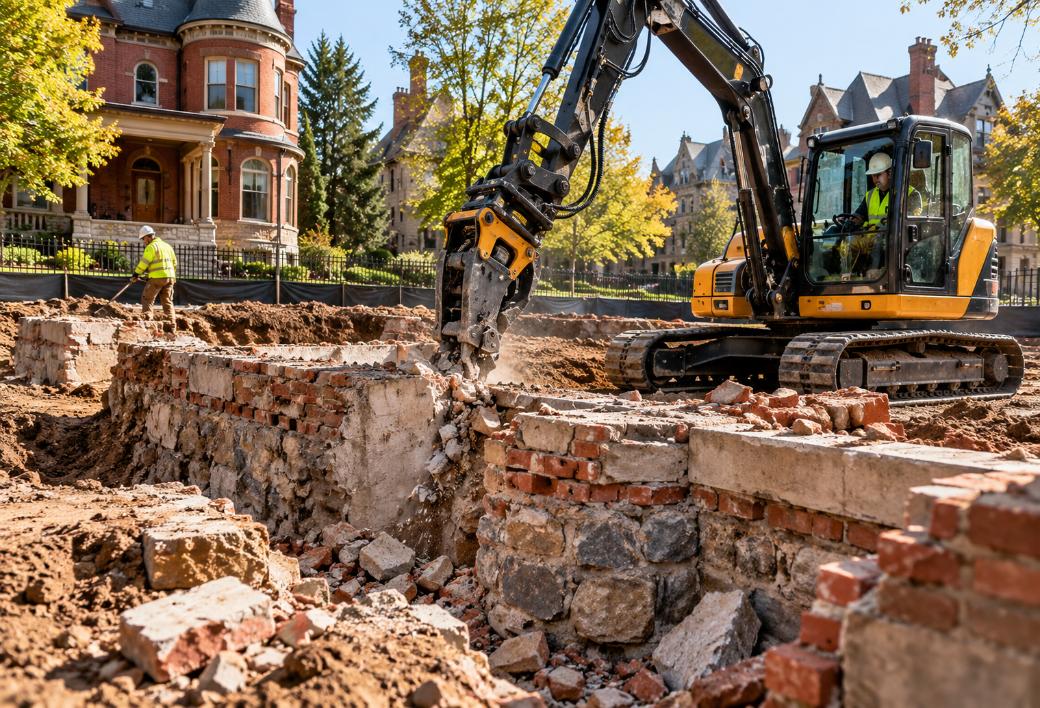
Managing Historic Foundation Removal in the Old West End: Zero-Vibration Excavation Strategies
Removing a foundation around a historic property requires a different approach than clearing concrete from an open construction site. In Toledo’s Old West End, closely spaced homes, mature streetscapes, aging masonry, and historically significant structures can make vibration control a central part of excavation planning.
Quick answer: Zero-vibration excavation strategies focus on removing soil, concrete, and foundation materials without relying on high-impact methods that can transmit unnecessary vibration into nearby structures. Depending on site conditions, contractors may use controlled saw cutting, hydraulic equipment, smaller excavation machinery, careful sequencing, and other low-impact techniques. The goal is to separate and remove materials while maintaining tighter control around older foundations, neighboring buildings, utilities, and confined work areas.
What local property owners should know
-
Historic structures may contain masonry, foundations, and finishes that are more sensitive to movement than newer construction.
-
The Old West End’s established residential setting can leave limited working room between excavation areas, neighboring homes, sidewalks, and streets.
-
Older sections of Toledo may contain site conditions and buried infrastructure that require investigation before excavation begins.
-
“Zero-vibration” does not mean that every piece of equipment creates literally no movement. It describes a strategy designed to minimize vibration-producing demolition and excavation methods.
-
Careful planning before removal can be just as important as the equipment selected for the work.
Why Does Foundation Removal Require Extra Care in Toledo’s Old West End?
Foundation removal in the Old West End requires extra care because historic buildings, close property spacing, older construction materials, and established infrastructure can increase the consequences of uncontrolled excavation. A removal method that works well on a large, open commercial property may not be appropriate beside an older home or other sensitive structure.
The Old West End is known for its concentration of historic architecture. Properties in and around the neighborhood can include older masonry, stone or brick foundation components, plaster finishes, and construction assemblies that deserve careful consideration when nearby concrete or soil is disturbed.
That makes planning especially important when work occurs near neighboring structures, sidewalks, porches, utility lines, or remaining portions of a building.
Klumm Bros. approaches excavation work by evaluating the conditions of the individual site rather than assuming one removal method fits every property. From that point forward, we can determine which equipment and sequencing are appropriate for the material, access, and surrounding structures involved.
What Do Local Site Conditions Tell Us About Low-Vibration Excavation?
Local site conditions show why foundation removal should be planned around the actual structure, access points, surrounding improvements, and subsurface conditions rather than around production speed alone. In established Toledo neighborhoods, excavation frequently requires more control than work on an undeveloped site.
This is best treated as a field-planning consideration rather than a claim that every Old West End property presents identical conditions. A historic house near Collingwood Boulevard, for example, may have different access and structural considerations than a project closer to Downtown Toledo or another part of Lucas County.
Before excavation begins, professionals may need to evaluate the foundation material, proximity of adjacent structures, equipment access, underground utilities, and what portions of the property must remain undisturbed.
How Can Vibration Affect Historic Properties?
Vibration can matter around historic properties because movement generated during demolition may transfer through concrete, soil, and adjoining structural materials. Older masonry, brittle finishes, previously repaired areas, and structures with existing deterioration can warrant additional caution before impact-intensive equipment is used nearby.
The concern is not simply whether a machine can break the concrete. Contractors also need to consider what is connected to that concrete and what surrounds it.
For local property owners, a more controlled approach can help reduce unnecessary disturbance while allowing foundation materials to be separated into manageable sections for removal.
What Warning Signs Make a Foundation Removal Site More Sensitive?
A foundation removal site deserves closer evaluation when existing structural conditions, tight access, or nearby improvements leave little margin for uncontrolled movement. These warning signs do not automatically prevent excavation, but they can affect the methods and equipment selected.
Watch for:
-
Existing cracks in nearby masonry, plaster, concrete, or foundation walls.
-
Older brick or stone components close to the planned excavation.
-
Very limited clearance between the foundation and a neighboring building.
-
Porches, steps, sidewalks, retaining walls, or other improvements immediately beside the work.
-
Visible settlement or uneven structural conditions.
-
Underground utilities located within or near the excavation area.
-
Portions of the original structure that must remain intact.
-
Restricted equipment access from alleys, driveways, or narrow side yards.
Documenting existing conditions before work starts can also provide a clearer picture of what is already present.
When Should You Call an Excavation Professional?
A professional should evaluate foundation removal when concrete, masonry, structural components, utilities, or nearby buildings could be affected by excavation. Property owners can document visible conditions and identify access concerns, but foundation demolition itself generally calls for appropriate equipment, planning, and jobsite controls.
This becomes particularly important in dense Toledo neighborhoods where work may occur only a short distance from another structure.
A professional evaluation can help determine how the material should be separated, what equipment can safely access the area, how debris will leave the site, and whether additional precautions are appropriate.
What Common Conditions Complicate Historic Foundation Removal?
The most common complications involve structural sensitivity, restricted access, unknown subsurface conditions, buried utilities, and the difficulty of separating materials without disturbing what needs to remain. In the Old West End, these factors can overlap on a single property.
Older construction is one concern. Tight residential lots are another. Mature trees, sidewalks, alleys, driveways, and neighboring buildings can further restrict where equipment can operate.
Seasonal conditions matter as well. Northwest Ohio experiences freezing winter conditions and wet periods that can influence soil and jobsite conditions. Scheduling excavation around current ground conditions can improve site control and equipment access.
How Can Property Owners Prepare for Controlled Foundation Removal?
Property owners can prepare by documenting existing conditions, identifying utilities and access limitations, defining what must remain, and having the site professionally evaluated before demolition starts. Good preparation reduces uncertainty once excavation equipment arrives.
Photograph visible cracks and existing damage around the work area. Identify structures, landscaping, pavement, or architectural features that need protection. Make sure the project scope clearly distinguishes materials being removed from components being retained.
DIY work should stop well before attempting to break or excavate structural foundation materials where nearby buildings or buried infrastructure could be affected.
What Results Can You Expect From a Low-Vibration Strategy?
A low-vibration strategy should provide more controlled removal and reduce reliance on aggressive impact methods, although the exact process depends on the foundation and site. It does not guarantee that surrounding structures will experience absolutely no movement or that every foundation can be removed using identical techniques.
The practical objective is control.
That can mean cutting material into planned sections, using hydraulic force instead of repeated impact where appropriate, selecting smaller equipment for confined spaces, and removing debris in a sequence that limits unnecessary disturbance.
What Mistakes Should Be Avoided During Historic Foundation Removal?
The biggest mistakes are treating historic foundation removal like ordinary concrete demolition, overlooking existing structural conditions, and selecting equipment before understanding the site. In a neighborhood such as Toledo’s Old West End, those shortcuts can create unnecessary complications.
Mistake: Starting with aggressive impact demolition.
Consequence: Vibration may travel beyond the material being removed.
Better approach: Evaluate whether cutting, hydraulic methods, or controlled sectional removal can accomplish the work with less impact.
Mistake: Ignoring existing cracks.
Consequence: It becomes harder to distinguish pre-existing conditions from changes noticed later.
Better approach: Document surrounding conditions before excavation.
Mistake: Planning only for removal.
Consequence: Equipment and debris may have no practical route through a tight property.
Better approach: Plan access, excavation, loading, and site restoration as one coordinated operation.
What Does a Common Old West End Foundation Removal Scenario Look Like?
A common local scenario involves removing an old foundation or concrete section while protecting nearby portions of a historic structure and working within a confined residential property. This is an illustrative scenario, not a Klumm Bros. project case study.
Imagine an older property near the Old West End where a concrete or masonry foundation section must be removed, but an adjacent structure remains. A large impact breaker may introduce more vibration than the project warrants.
A controlled plan could instead isolate sections, use appropriate cutting or hydraulic techniques, remove material progressively, and use excavation equipment sized for available access. The exact sequence would depend on an onsite assessment.
Which Services Support Controlled Foundation Removal?
Excavation and demolition services can support controlled foundation removal by combining material separation, excavation, debris handling, and site preparation within one coordinated plan. The specific services required depend on whether the project involves complete demolition, selective removal, redevelopment, or preparation for new construction.
We can evaluate the work area and determine what approach fits the structure, access, and surrounding property.
How Do Low-Vibration and Conventional Removal Methods Compare?
Low-vibration methods prioritize control around sensitive structures, while conventional impact methods may prioritize faster material breakup where surrounding conditions allow it. Neither approach should be selected solely by habit.
For an open site with adequate separation, conventional equipment may be practical. Around historic masonry, occupied neighboring properties, or components that must remain, controlled cutting and hydraulic methods may provide important advantages.
The correct choice comes from matching the removal method to the actual Toledo site.
Where Are These Excavation Considerations Relevant?
These excavation considerations are especially relevant throughout Toledo and established communities where older structures, close property lines, and existing infrastructure affect access. That includes the Old West End, areas near Downtown Toledo, and other older neighborhoods throughout the city and Lucas County.
Every property still requires its own evaluation because building age alone does not determine the correct excavation method.
What Can Happen If Sensitive Foundation Removal Is Poorly Planned?
Poor planning can increase the risk of unnecessary structural disturbance, property damage, project delays, access problems, and additional repair work. Waiting until demolition is underway to address tight clearance or sensitive adjacent materials can make a difficult Toledo excavation even more complicated.
Planning the removal sequence first gives contractors an opportunity to account for existing conditions before heavy work begins.
FAQ
Is zero-vibration excavation literally vibration-free?
No, zero-vibration excavation should not be interpreted as a promise that absolutely no vibration or movement will occur. Equipment operation and material handling can still produce movement. The strategy is to minimize vibration-intensive methods and use more controlled techniques when surrounding structures or site conditions warrant additional protection.
Why is vibration control important in Toledo’s Old West End?
Vibration control can be important because the Old West End contains historic structures and established residential properties where excavation may occur close to existing buildings. Older masonry and finishes may also warrant additional caution, particularly when the project requires removing material immediately beside components that will remain.
Can an old foundation in Toledo be removed without a jackhammer?
Some foundations can be removed with techniques that reduce or avoid extensive impact hammering, but the correct method depends on the material and site. Saw cutting, hydraulic equipment, sectional removal, and excavation machinery may be options. An onsite evaluation is needed before determining which approach is practical.
Does a historic Toledo property automatically require zero-vibration excavation?
No, historic status alone does not determine the excavation method. The condition of the structure, foundation material, distance to neighboring buildings, access, utilities, soil conditions, and project scope all matter. Historic properties simply provide a strong reason to evaluate vibration and surrounding conditions carefully before demolition begins.
Should existing cracks be documented before excavation?
Yes, documenting visible existing conditions is a sensible step before excavation near older structures. Photos can record cracks, masonry conditions, pavement, walls, and other features near the work area. For sensitive Old West End projects, additional professional evaluation may also be appropriate depending on the structure and scope.
Do Northwest Ohio seasons affect foundation excavation?
Yes, seasonal ground and weather conditions can affect excavation logistics in Northwest Ohio. Frozen ground, wet soil, precipitation, and changing site conditions can influence access and equipment operation. Contractors should evaluate current conditions rather than assuming the site will behave the same way throughout the year.
Can foundation removal be performed on a tight residential lot?
Yes, some tight residential sites can be excavated using carefully selected equipment and sequencing. Limited access may influence machine size, debris handling, cutting methods, and the order of removal. Older Toledo neighborhoods can make this planning especially important because buildings and improvements may sit close to the work zone.
Do I need permits for foundation removal in Toledo?
Permit requirements depend on the specific project, property, and scope of work. Historic properties can also involve additional considerations depending on their status and the work proposed. Property owners should confirm current requirements with the appropriate City of Toledo authorities before demolition or excavation begins rather than assuming a permit is unnecessary.
Protect the Property While Planning the Removal
Historic foundation removal calls for more than enough power to break concrete. In the Old West End and other established Toledo neighborhoods, the better approach is to understand the structure, surrounding property, access, and excavation conditions before selecting a removal method.
Plan a More Controlled Foundation Removal in Toledo
A carefully planned excavation strategy can help limit unnecessary disturbance while keeping the project focused on the material that actually needs to be removed.
Categorised in: Excavation Company